

Our Team
Wendy Barillas
Licensed Marriage and Family Therapist #133716
View ProfileExplore counseling options. Request an Appointment.
Young People and Families
Children and teens often communicate through behavior, play, and connection. We partner with parents while making room for each young person's experience.
01
We understand the complex relationship between parents and children/teens. Our therapists offer support that helps build better relationships within the family. We can create a safe place for them to talk about difficult topics affecting their lives.
Adolescence can be a difficult time for both teens and their families. Our adolescent counseling services are designed to help teens cope with the challenges of growing up, including peer pressure, academic stress, family issues, and mental health concerns. Our therapists provide a safe and supportive environment where teens can express themselves, gain insights, build self-esteem, and develop effective coping skills.
02
Children and teens do not always describe stress, grief, trauma, relationship concerns, or emotional needs in the same way adults do. Their experience may appear through play, behavior, withdrawal, conflict, worry, school stress, self-esteem concerns, or changes that are hard for the family to understand. Counseling can offer another way to communicate and connect.
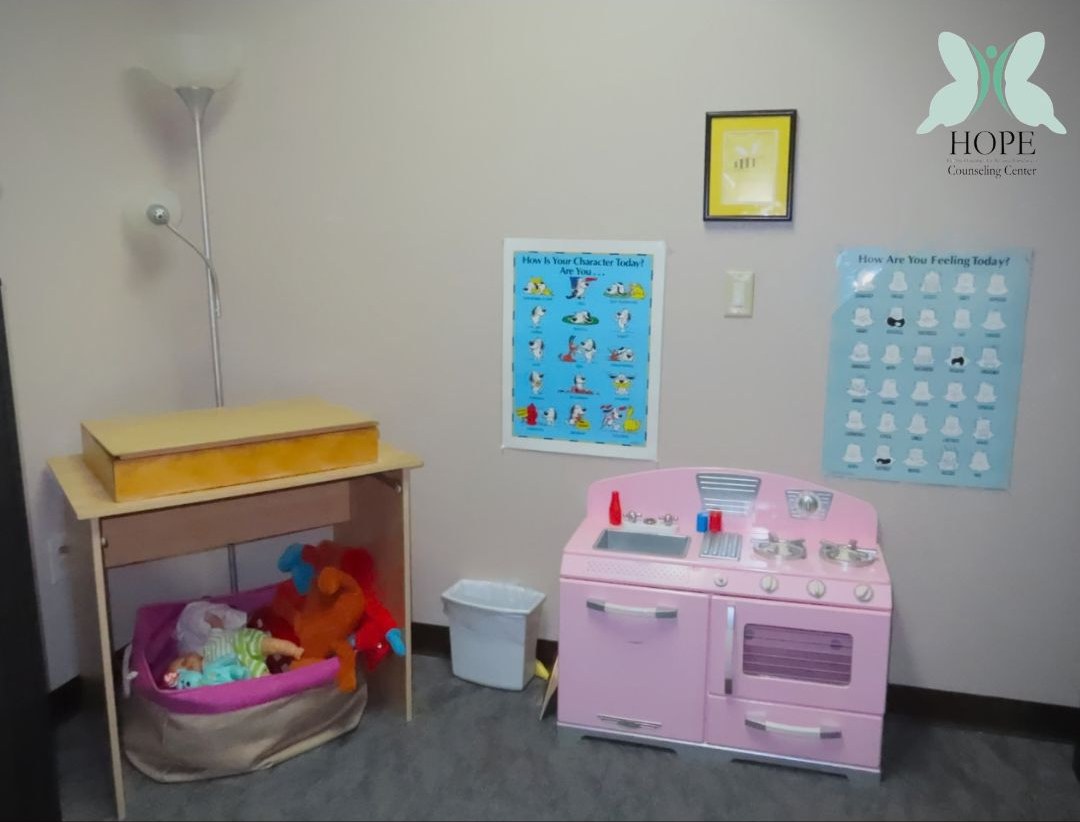
For younger children, play can express what is difficult to put into words. HOPE has two children's rooms designed to make room for play and connection. Wendy uses play therapy and Parent-Child Interaction Therapy. Megan incorporates somatic tools that attend to how emotions and stress show up in the body.
Teens may want a place to talk about peer pressure, academic stress, relationships, identity, coping, anxiety, depression, grief, trauma, or life transitions. A therapist can offer a collaborative setting where the young person is heard while recognizing that parents and caregivers remain important partners in the process.
Our team brings varied experience with young people. Wendy works with children and families affected by abuse, neglect, attachment wounds, and other adverse experiences. Eva works with children, adolescents, adults, couples, and families. Megan spent twenty-five years as a teacher before becoming a therapist and works with children, teens, parents, and families. Hanna previously spent three years as a Registered Behavior Technician working with neurodivergent children.
03
A parent or caregiver can begin by sharing who needs support and a brief description of the concern. You do not need to include private clinical details in email or voicemail. Our therapist profiles describe age groups, focus areas, and approaches so you can explore possible fits before reaching out.
The therapist can discuss how parent participation and individual time may fit the work. Counseling can take place in person in Roseville or by secure video when the client is located in California, depending on what is appropriate and the therapist you work with.
04
Counseling at HOPE is collaborative and shaped around the person, couple, or family in the room. We do not begin with a preset definition of success. Instead, your therapist makes space for what matters to you, helps you identify personal goals, and works with your experiences and strengths. You can talk about what feels difficult, notice patterns, and decide together where to focus.
Our therapists bring different backgrounds and approaches to this work. Some draw from attachment-based, relational, psychodynamic, parts-informed, somatic, emotion-focused, or cognitive behavioral perspectives. Trauma-informed approaches available within the practice include EMDR, Brainspotting, and Trauma-Focused CBT. Work with children and families may also include play therapy and Parent-Child Interaction Therapy. The approach used depends on the therapist, the client, and the goals you discuss together.
The relationship between client and therapist matters. Our team aims to offer a setting grounded in trust, collaboration, communication, and respect. You can ask questions, share what is or is not helpful, and move at a pace that respects where you are. Therapy can include honest conversation, attention to emotions and relationships, and practical ways of understanding what you are experiencing.
05
A first step does not require having everything figured out. You can read our therapist profiles, or call or email us and we will help you find a good starting point. If you have a therapist preference, let us know. If you do not, we can help identify a good starting point based on the concern, who will attend, the way you would like to meet, and any language preference.
HOPE offers counseling in person at our Roseville office and by secure video for clients who are located in California during the session. Wendy offers counseling in English and Spanish. A therapist will contact you within 48 hours, Monday through Friday. Before beginning, you can ask questions and learn what to expect so that the next step feels clear.
Questions
Meet the Team
Our Team
Licensed Marriage and Family Therapist #133716
View Profile
Our Team
Registered Associate Marriage and Family Therapist #144286
View Profile
Our Team
Marriage and Family Therapist Trainee
View ProfileOur Team
Marriage and Family Therapist Trainee
View ProfileBegin Here