

Our Team
Wendy Barillas
Licensed Marriage and Family Therapist #133716
View ProfileExplore counseling options. Request an Appointment.
Child and Family Approach
Play is a language children already speak. Play therapy gives a child room to show, through toys, games and stories, what can be hard to put into words.
01
When adults have a hard week, many of us talk it through. Children often work through the same things differently. A young child may not have words for fear, anger, confusion or sadness, yet those feelings can surface in how they build, sort, pretend and act out stories. Play therapy treats that play as communication, giving a child a way to express what is happening inside without needing to explain it.
A play therapist watches and listens closely. A theme that keeps returning, a toy figure who always needs rescuing, a game that suddenly stops, or a moment when calm returns can all say something about what a child is carrying. The therapist responds with warmth and curiosity, helping the child feel seen and understood without pressing for explanations they cannot yet give.
From the outside, play therapy can look like ordinary play, but it is guided by a trained therapist with a purpose in mind. Along the way, a child can practice naming feelings, handling frustration, making choices and trying new ways through a problem, all within a relationship that feels safe enough to explore.
02
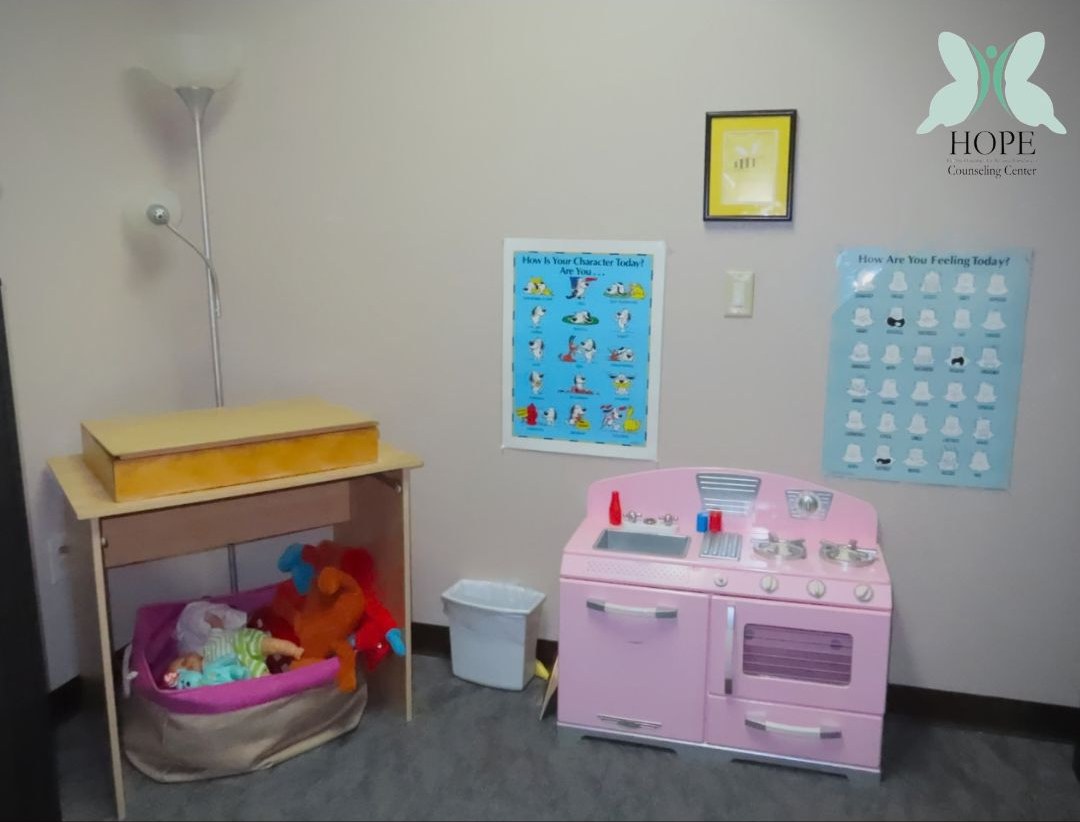
HOPE's Roseville office has two children's rooms. One has a play kitchen and toy shelves. The other has a purple sofa and shelves of toys and games. Both rooms are meant for play and connection, so a child can choose what to reach for, whether that is a pretend meal in the kitchen, a game from the shelf or a spot on the sofa.
Wendy Barillas, Licensed Marriage and Family Therapist #133716, is trained in play therapy and uses it within her child and family counseling. Her work with children includes those who have faced abuse, neglect, attachment wounds or other adverse experiences, and her training also includes Trauma-Focused CBT, Parent-Child Interaction Therapy and attachment-based approaches. Play can be one part of the work, sitting alongside other ways of supporting a family when that fits.
When you reach out, you can ask which formats are available for your child and mention anything that might help them feel at ease, such as a favorite kind of play or something that tends to make new places hard. Wendy counsels in English and Spanish, so you can also let us know if a parent or caregiver would prefer to speak in Spanish.
03
You know your child's history, routines and recent changes better than anyone, so parents and caregivers remain important partners in play therapy. The therapist can talk with you about how your involvement will work, including what is shared from sessions, how you can support your child at home, and whether time together might help.
A first visit can be mostly about getting comfortable. The therapist may let your child explore the room, choose something to play with, and get to know a new adult at their own speed. There is nothing your child has to say, explain or perform. Learning that this room and this person feel safe is an important beginning in itself.
You can also ask whether the therapist would like to speak with you before your child's first visit. When you contact us, a short description of who the counseling is for and what has felt hard is plenty. Please keep private clinical details out of email, voicemail and the website form, since there will be time to share more with the therapist directly.
04
No single approach defines counseling at HOPE. Our therapists work collaboratively, learn about the person and concern in front of them, and shape care around individual goals. An approach may be one part of the work, and you can ask questions or discuss another direction at any time.
The therapeutic relationship remains central. Your therapist will explain what they are inviting you to do, listen to your response, and respect your pace. You do not need to arrive knowing which method you want. Therapist profiles can help, or call or email us and we will help you find a good starting point.
HOPE offers counseling in person in Roseville and by secure video when the client is physically located in California. When you reach out, you can name an interest in a particular approach or simply describe what you would like support with.
Questions
Meet the Team
Begin Here